Finding a reliable commercial partner starts with an evaluation of their experience and expertise to ensure a proven track record for meeting a deadline. How to Choose the Best Commercial Painting Contractor for Your Business is vital for asset protection in Boston, MA.
Property managers and business owners of any retail space or warehouse need a painter who understands business operations and scheduling the work. In 2026, a commercial painting contractor provides more than a fresh coat; they offer a specialized coating and high-quality workmanship to ensure your painting project delivers long-term results.
Ways to identify & Choose a Commercial Painting Contractor: The 6-Phase Framework
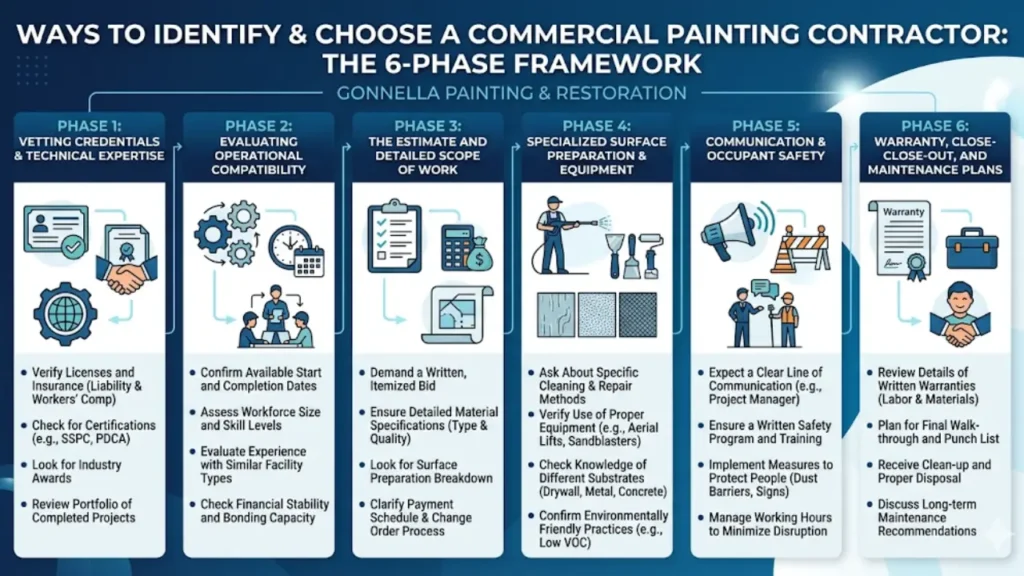
The best commercial way to evaluate a painting contractor is to look past the price tag and analyze their technical expertise, safety record, and ability to meet your project needs. Selecting a painting company that can handle a large-scale painting project requires a structured approach. If you work with the wrong industrial painting contractor, you risk project delays, property damage, and legal liability. Use the following six phases to find the right professional team, like Gonnella Painting & Restoration, that can deliver exceptional results.
Phase 1: Vetting Credentials & Technical Expertise
The foundation of any professional commercial painting relationship is proof of legitimacy. For commercial sites, a standard “handyman” policy is a massive risk to your space.
- Licensing and Insurance: You must verify that the contractor carries at least $1M–$5M in General Liability insurance. Robust Workers’ Compensation is also a non-negotiable requirement to protect your business from a lawsuit if an injury occurs on-site.
- Bonding Requirements: Always ask if the company is bonded. Bonding provides a financial guarantee that the project will be finished according to the contract. This is essential for municipal or high-stakes corporate work.
- Industry Certifications: High-level expertise is often backed by credentials from NACE or SSPC. These prove the painter understands the chemistry behind adhesion and industrial-grade paint application.
Phase 2: Evaluating Operational Compatibility
A true commercial partner knows that your business cannot simply stop for a repaint. You need a team that puts the “Business First” and offers top-tier customer service.
- Off-Hours Scheduling: Ask if they can work nights, weekends, or third shifts. The goal is zero downtime. You shouldn’t have to close your doors to customers just to get a fresh coat of paint.
- Project Management Infrastructure: Avoid the “man in a van” setup. A professional painting company should provide a dedicated site supervisor. This expert is your single point of contact for clear communication throughout the project.
- Safety Protocols & EMR Ratings: Check their EMR (Experience Modification Rate). An EMR above 1.0 suggests a poor safety record. A safe contractor protects your employees and reduces the risk of a workplace accident in your liability coverage.
Phase 3: The Estimate and Detailed Scope of Work
When comparing contractor estimates, the lowest price is rarely the best value. In fact, it’s often a red flag for early paint failure.
- The “Low Ball” Danger: If a bid is 30% lower than the rest, the contractor is likely skipping primer or cutting corners on surface preparation. Proper prep work is 80% of the work; without it, the paint film will flake and peel within two years.
- Line-Item Transparency: A professional bid should be broken down into Surface Prep, Priming, Finish Coating, and Clean-up. This allows you to compare “apples to apples” and ensures no hidden costs pop up later.
- Product Specifications: Ensure they specify quality paint specifically, high-solids commercial-grade coatings. Using residential latex in a high-traffic retail space is a mistake that leads to fast wear and tear.
Phase 4: Specialized Surface Preparation & Equipment
Commercial surfaces often require much more than a simple sand or scrape. You need a team equipped for the “heavy lifting” of industrial prep.
- Industrial Cleaning: Depending on the substrate, your contractor might need to use power washing, abrasive blasting, or chemical stripping. Removing grime, oil, and dirt is the only way to ensure proper paint adhesion.
- The Equipment Arsenal: Does the contractor own their own boom lifts, scaffolding, and high-volume spray painting units? Relying on third-party rentals can cause major scheduling delays if the equipment isn’t available when your “third shift” window opens.
Phase 5: Communication & Occupant Safety
If you are painting a hospital, school, or restaurant, the health of the people inside is the top priority.
- Odor and Vapor Management: Modern commercial painters should use Zero-VOC or Low-Odor coatings. This prevents “sick building syndrome” and ensures your staff and customers aren’t breathing in harmful fumes.
- Site Protection Protocols: How will they protect your sensitive electronics, inventory, or specialized flooring? A professional team like Gonnella Painting & Restoration will provide a detailed plan for masking and containment to keep your assets safe.
Phase 6: Warranty, Close-out, and Maintenance Plans
The job isn’t done just because the painter packed up their brush. You need long-term security..
- The “Labor + Material” Warranty: Avoid a warranty that only covers “labor.” If the paint loses its bond because the product was faulty or applied incorrectly, you want a warranty that covers the whole fix.
- The Maintenance Cycle: A great contractor provides a Touch-Up Kit and a scheduled maintenance plan. Regularly checking for paint cracks or chips can extend the life of your paint job by years, saving the business thousands in the long run.
Why “Cheaper” Leads to Paint Failure
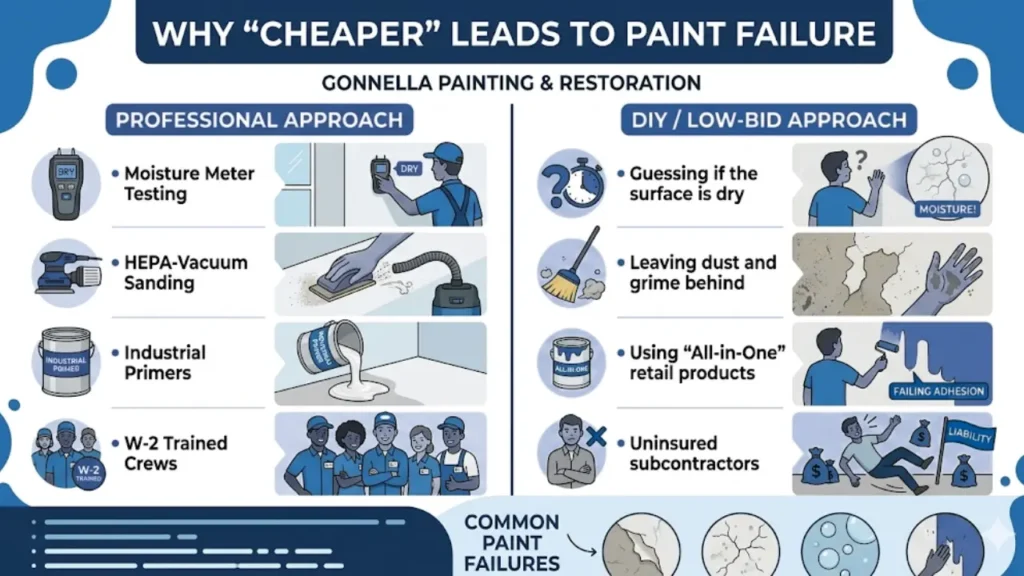
In commercial painting, you truly get what you pay for. When a contractor gives a low estimate, they often save money by skipping primer or using a new coat of low-quality paint that doesn’t have the adhesion needed for metal or masonry. This leads to early paint failure, where the coating begins to bubble or flake off. This damages your building’s aesthetics and your reputation on Google and with the Better Business Bureau.
| Professional Approach | DIY / Low-Bid Approach |
| Moisture Meter Testing | Guessing if the surface is dry |
| HEPA-Vacuum Sanding | Leaving dust and grime behind |
| Industrial Primers | Using “All-in-One” retail products |
| W-2 Trained Crews | Uninsured subcontractors |
FAQs
Can I install a window AC without a bracket?
While smaller units might stay put with the window sash, I’d always recommend an external support bracket. It’s the best way to keep the unit in place and stop it from falling, protecting your property for years to come.
Do I need a dedicated wall outlet for my window AC?
Yes, you really do. Plugging into a grounded wall outlet on its own circuit stops tripped switches and fires. Never use an extension cord, as it can damage the printed circuit board.
How do I make sure the unit drains properly?
The ac unit needs a slight tilt toward the outside. This makes sure condensation runs off the window sill and drains outside your home instead of into your wall, preventing rust and corrosion.
What should I do if my window AC isn’t blowing cool air?
First, check the air filter every few weeks. If that’s clean, you might have a refrigerant leak. You’ll need a professional painting of the situation or a technician to avoid a full replacement cost.
Are window units safe from burglars? To safely install for security, use a window sash lock so the window space can’t be lifted from the outside. This gives business owners extra peace of mind.
Choose Wisely
Choosing the right commercial painting contractor is about finding a partner who values your workmanship as much as you do. By checking references and previous clients, you ensure a successful painting project. Remember, a cheap paint job is the most expensive one you’ll ever buy.
Gonnella Painting & Restoration is dedicated to providing the quality commercial painting that Boston, MA businesses require. We understand the unique requirements of completing projects on time. Painting today with us means your color choices and finish will last. Ready to protect your investment? Contact Gonnella Painting & Restoration today for a detailed commercial painting estimate and find the right solution for your retail space.